Gelco Chimney Sweep in Hollywood: A Homeowner’s Guide
Gelco chimney components don’t fail silently. The caps corrode at the seams first, the dampers stick before they seize, and the liners show hairline fractures you can spot from the roofline with a pair of binoculars. We wrote this guide because Hollywood homeowners keep asking us the same question: “What does Gelco actually make, and how do I know if mine needs attention?” Here’s the short version: Gelco manufactures chimney caps, dampers, and chase covers, they’re common in mid-century and newer Hollywood construction, and most problems reveal themselves visually long before they become structural. If you’d rather not climb up there yourself, call (866) 520-4943 and we’ll handle the inspection.
Before you book anything, it helps to understand what’s installed in your system. A homeowner who knows the difference between a Gelco top-mount damper and a throat damper can evaluate a quote in thirty seconds. A homeowner who doesn’t just has to take someone’s word for it.
What Gelco Actually Manufactures and Where It Lives in Your Chimney
Gelco isn’t a sweep company. It’s a chimney components manufacturer that supplies hardware to trade professionals, and its products appear in thousands of Hollywood homes without owners ever knowing the brand name. Their catalog centers on three product lines that matter to residential chimneys: chimney caps, dampers, and chase covers.
Chimney caps sit at the very top of the flue and do two jobs: keep rain and wildlife out, and serve as a spark arrestor that prevents embers from landing on your roof or a neighbor’s dry brush. In Hollywood’s fire-prone hillside neighborhoods, a functioning spark arrestor isn’t just maintenance. It’s a code and insurance concern.
Dampers live either at the top of the flue (top-mount, which Gelco is known for) or just above the firebox (throat-mount). A top-mount damper seals the flue from the top with a gasketed lid, which keeps conditioned air inside your house instead of letting it draft up and out. In a city where air conditioning runs from May through October, that seal quietly matters on every utility bill.
Chase covers cap the top of factory-built chimneys, the framed, sided enclosures you see on many newer Hollywood homes with gas fireplaces. A chase cover is the metal roof over that wooden structure. When it leaks, water runs down inside the chase, rots the framing, and eventually puddles at the base of the fireplace. Most homeowners never see it until it’s already wet.
These aren’t interchangeable with hardware store parts. Gelco fabricates to specific gauge thicknesses and uses stainless or galvanized finishes meant to survive years of UV and thermal cycling. We use Gelco components alongside Olympia Chimney and Copperfield hardware because the material consistency matters when you’re fabricating and fitting parts on a live chimney system.
Service Life in Hollywood: UV, Thermal Cycling, and Why Our Climate Wears Components Differently
Here’s a fact most generic sweep content misses: a chimney cap in Hollywood ages differently than the same cap in Chicago or Seattle. In cold climates, freeze-thaw cycles attack masonry and metal through ice expansion. We don’t get that. What we get is relentless UV exposure, summer thermal cycling that swings a metal cap from 65 degrees overnight to 140 degrees on an August afternoon, and a long dry season with very little rinse from rain.
So what does that mean in practical terms for Gelco components?
- Galvanized caps and chase covers: expect a 7 to 12 year functional lifespan in Hollywood before seam corrosion or rust breakthrough. UV degrades the coating, then morning dew and the rare rain event work the seams.
- Stainless steel versions: these routinely last 15 to 25 years here, sometimes more. The limiting factor becomes the fasteners and the screen mesh, which trap creosote and soot and eventually clog or corrode where they contact the cap frame.
- Top-mount dampers: the metal lid and gasket typically give 10 to 15 years in Hollywood. The cable and handle mechanism, however, is the weak point. Cables stretch, handles snap where they mount to the firebox, and the gasket material dries and cracks in our low-humidity environment long before the lid itself fails.
- Throat dampers: these rust and warp from direct flame exposure and creosote contact. In a wood-burning Hollywood fireplace used two to three nights a week during the winter season, a throat damper commonly needs replacement every 8 to 12 years.
We pulled a Gelco top-mount damper out of a fireplace in the Hollywood Hills last month where the gasket had turned brittle and was letting air draft through the flue. The homeowner’s complaint wasn’t the damper at all. It was that the upstairs hallway always felt cold in winter and the fireplace room never cooled properly in summer. A fifteen-dollar gasket replacement fixed what they’d assumed was an HVAC problem. That’s why knowing the components matters.
How to Identify a Gelco Cap or Damper Before You Book a Sweep
You can verify what’s on your chimney without touching it. We’ll walk you through what to look for so the next time someone quotes you a replacement, you can confirm the brand and condition yourself.
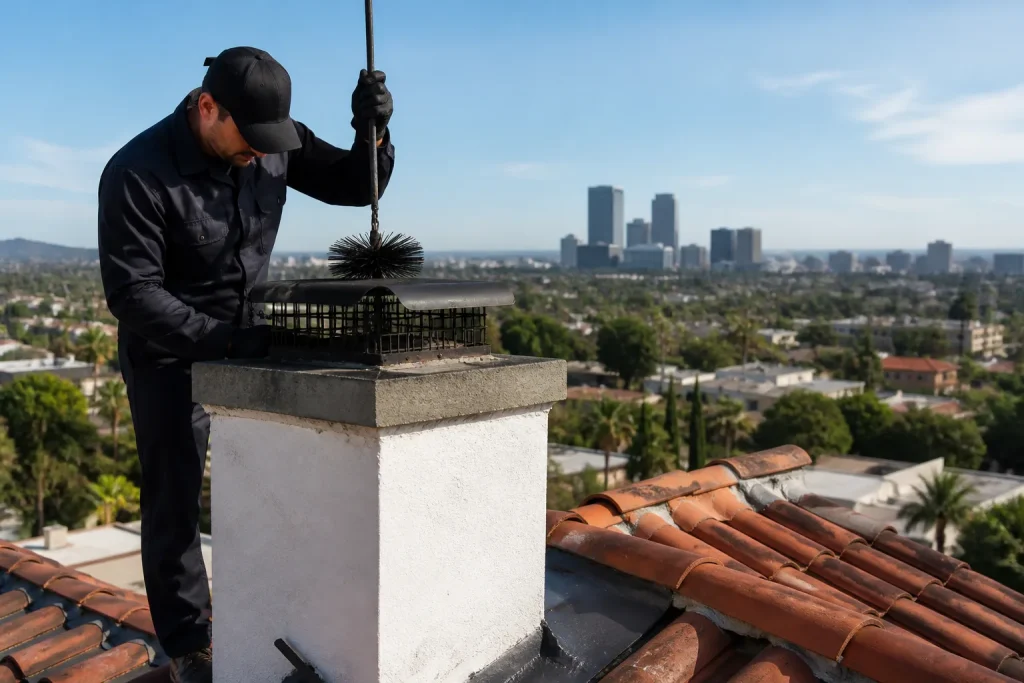
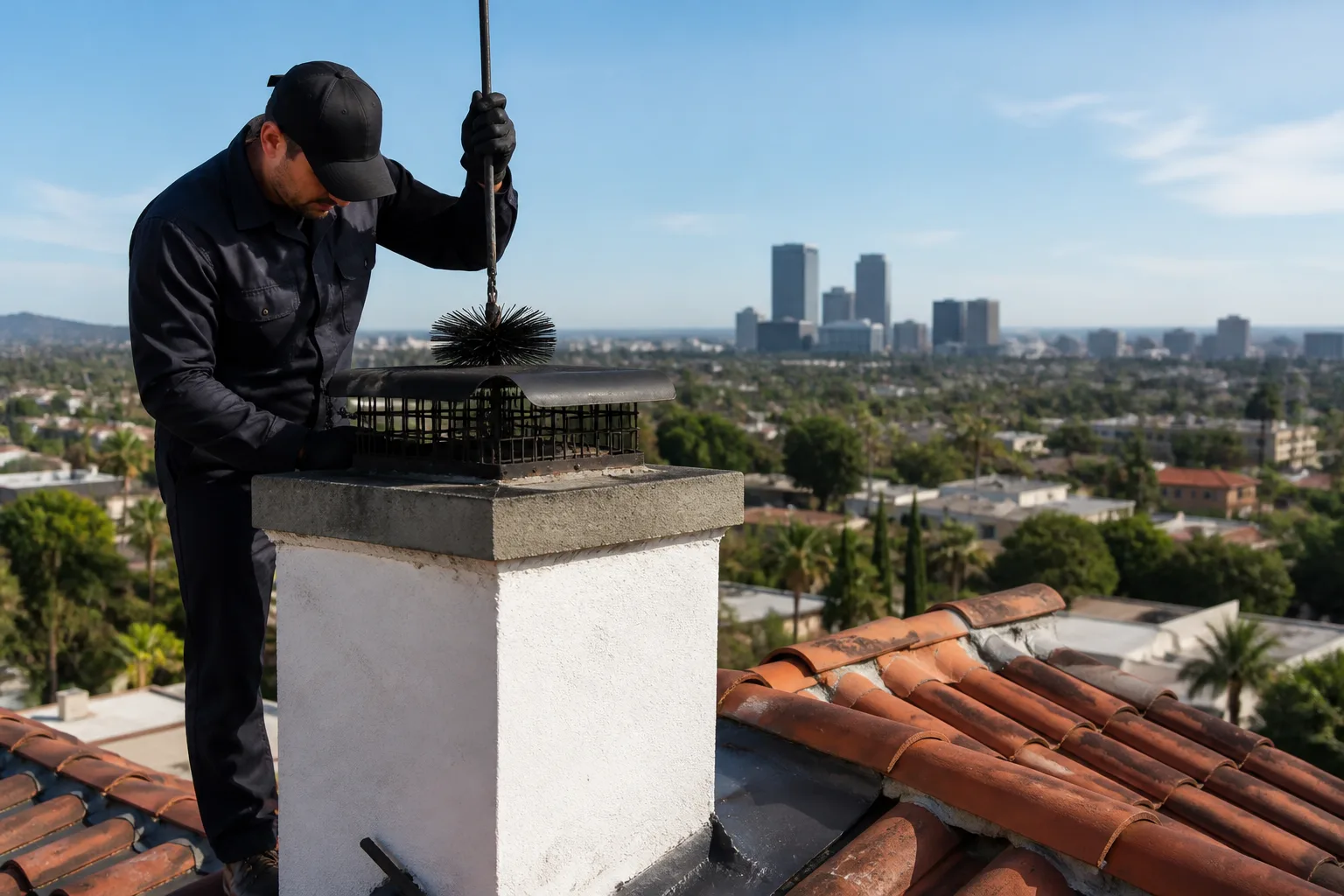
From the roofline or a ladder, look at the cap: Gelco caps typically have a solid top plate with rolled or crimped edges and a mesh band around the sides. The screen mesh on a Gelco cap is noticeably heavier gauge than the flimsy stuff on hardware-store caps. If you can see surface rust streaking down the sides, especially at the seam where the top plate meets the mesh band, that’s a galvanized cap nearing replacement age. If the cap is still clean silver-grey after a decade, you likely have stainless.
From inside the firebox, look up at the damper: a Gelco top-mount damper will have a metal cable running from the damper mechanism down to a handle or rotary mount near the firebox opening. You’ll see a spring-loaded lever or a small pulley bracket. If you can open and close it and feel resistance change, that’s good. If the handle moves freely with no change in feel at the top, the cable has either stretched past function or disconnected from the lid.
On a chase cover, look at the seams: the chase sits at the top of a factory-built chimney, usually capped with a sloped metal pan. Gelco chase covers are fabricated with folded corner seams and a bead of sealant along the folds. Walk out to the curb with binoculars. If you see rust at the corners or a visible gap where the chase cover meets the siding, water’s getting in. It’s not an emergency today, but it’s a predictable problem.
Most Hollywood homes built after 1980 with gas fireplaces have factory-built chimneys, not masonry ones. That means chase covers, not brick crowns. If you’re in an older section of Hollywood, Beachwood Canyon, or the streets east of Cahuenga, you’re more likely to see masonry chimneys with traditional caps and throat dampers. The housing stock varies block by block here, and the component mix follows it.
The Most Common Failure Modes and Their Early Warning Signs
Every component has a signature failure pattern. Once you know them, you’ll catch problems months or years before they become expensive. Here’s what we look for on Gelco components specifically, based on the patterns we see in Hollywood service calls.
- Gelco cap screen clogging: in wood-burning systems, creosote builds on the mesh and eventually blocks airflow. The symptom is smoke backing into the room at the start of a fire or a sluggish draft. You can see it from below: the mesh will look dark and crusted rather than open. Annual sweeping usually resolves it, but heavy buildup requires removing and cleaning the cap itself.
- Gelco cap seam corrosion: as the zinc coating breaks down, rust starts at the seams and spreads. Early sign: fine rust powder washing down the brick or siding below the cap after rain. Replace the cap at this stage and you’ve spent a few hundred dollars. Wait until the top plate perforates and water pours directly down the flue, and you’re now repairing the flue liner too.
- Gelco top-mount damper cable failure: the most common failure by far. Handle spins or pulls with no resistance. The damper lid is stuck open, which means heated and cooled air streams out of your house year-round. This is a mechanical fix, not a structural one, and it’s usually a same-visit repair for a sweep who stocks the parts.
- Gelco chase cover leak: water stains on the ceiling near the fireplace, or a musty smell from the firebox in the fall, both point to a chase cover that’s failed. The leak itself is easy to fix with a fabricated replacement. The damage behind it, rotted framing inside the chase, is what turns a $400 replacement into a $1,500 repair.
- Throat damper rust-through: if the damper plate above the firebox has visible rust or light showing through pinholes, it’s done. A failed throat damper that’s stuck closed makes the fireplace unusable. One stuck open lets a steady flow of conditioned air escape, just like a failed top-mount gasket.
None of these failure modes require immediate intervention in most cases. What they require is an honest assessment of what’s actually wrong, which is why camera inspection matters. Any company can tell you a damper “needs replacing.” A good one should be able to show you the cable, the gasket, or the corrosion on camera and explain what would happen if you waited another year. Sometimes the answer is “you can wait.” We’ve told plenty of Hollywood homeowners exactly that.
Gelco vs. What You Get at a Hardware Store: Why the Sourcing Chain Affects the Final Price
This is the part most guides skip, and it’s the reason the price you pay varies so much between companies. Gelco components are trade-grade. They’re sold through chimney industry supply chains to professionals who install them. They are not stocked at home centers.
Here’s what that means when you need a replacement. A hardware-store cap runs $40 to $80 and lasts three or four Hollywood summers before the screen rusts out and the top plate warps. A Gelco or Copperfield or Olympia cap runs more, but it’s fabricated from heavier-gauge metal with a real coating spec, and it’s sized to your flue, not a generic 8×8 square. The durability difference is not subtle.
The more immediate question is markup and lead time. If a sweep company doesn’t stock Gelco and doesn’t do repair work, they either refer you out or buy the part retail from a third-party supplier, mark it up, and pass the wait time on to you. A full-service company like Firebrick Chimney Sweep that carries Gelco, Olympia Chimney, Copperfield, and Famco components in inventory can typically do a cap or damper replacement in one visit: diagnose, fabricate or pull the part from stock, install, and verify. That’s the difference between one trip and three, and it shows up in the final bill.
It’s the same logic we apply to chimney repair overall. We sweep it, we repair it. One company, no referrals. If a sweep identifies a cracked flue liner, a rusted damper, or a failing chase cover, we can address it before we leave: HeatShield ceramic resurfacing instead of a full reline where that’s appropriate, or a DuraFlex liner where a full replacement is genuinely needed. That’s not a pitch. That’s the structural reality of the trade: the company that can actually repair what it finds during a sweep operates differently than the one that only writes a report and hands you a referral card.
When to Call a Pro and Related Services in Hollywood
This is the moment where we’ll be direct about it. Climbing onto a roof in Hollywood, finding your footing on a 6/12 pitch of concrete tile while leaning over a chimney chase, is not a weekend project. It’s how people end up in urgent care. If you want to visually verify your cap or damper from the ground with binoculars, go for it. If the inspection requires actually touching anything, getting on the roof, or opening a chase cover that’s been sealed for fifteen years, call someone who does this every day.
We handle the full scope in Hollywood. That includes Chimney Sweep in Century City for annual maintenance and creosote removal, Chimney Repair in Century City for the structural work: caps, dampers, chase covers, liners, and Dryer Vent Cleaning in Century City for the ventilation risk most Hollywood homeowners overlook. Dryer vents and chimneys share the same core risk: restricted, dirty ventilation that becomes a fire. We treat both with the same seriousness, and in Hollywood’s densely packed hillside lots, that seriousness isn’t optional.
What happens when you call
- 1
A real person answersNo phone trees — you reach a local pro.
- 2
You get an upfront price rangeHonest numbers before anyone is dispatched.
- 3
A background-checked tech heads outLicensed & insured, dispatched right away.
- 4
You approve before work beginsNothing starts until you say go.
The Bottom Line
Gelco components are good hardware. They’re not the cheapest and not the flashiest, but they’re spec’d properly, sized to the system, and they hold up here as well as anything on the market. The key is knowing what you have, watching for the failure signatures we described, and replacing parts when they start to fail rather than after they’ve already caused water or venting damage. A cap that’s rusted through at the seams costs three hundred dollars to replace today and three thousand to replace after it floods your flue liner for two rainy seasons. Same cap. Different timing.
If you’re in Hollywood and want an honest look at what’s on your chimney, we’ll put a camera up there and show you exactly what we see. Nothing gets recommended without visual evidence you can review yourself. If you decide to move forward, we carry the parts and do the repair same visit, barring special-order sizing. Call (866) 520-4943 for a free estimate. If you’d rather climb up and look yourselves, be careful up there. And if you see rust streaks, don’t ignore them.
Frequently Asked Questions
A Gelco chimney cap replacement in Hollywood typically ranges from $300 to $650 installed, depending on flue size, material choice (galvanized vs. stainless), and whether the old cap requires removal of seized hardware from the flue tile. Custom chase covers run more, often $500 to $900. The variance comes mostly from material spec and access difficulty; hillside homes with steep roof pitches cost more because it takes longer and requires more setup to work safely. Call (866) 520-4943 for an exact quote on your setup. Estimates are free.
Yes. Gelco is a trade-grade manufacturer that supplies chimney professionals, not home centers. Their caps and top-mount dampers use heavier-gauge metal and better coating specs than consumer alternatives, and their products are designed for professional installation and long service life. It’s not the only good brand we use, Olympia Chimney and Copperfield make quality hardware too. But when a Gelco cap is maintained and the screen is kept clean, it will commonly serve a Hollywood home for a decade or more before seam corrosion becomes a concern.
You can absolutely use a throat damper if it’s in good shape. The reason we recommend top-mount dampers for Hollywood homeowners, and why Gelco’s line is popular here, is efficiency. A top-mount damper seals the entire flue from the top, which means your air-conditioned air isn’t drafting up the chimney all summer and your heated air isn’t disappearing all winter. It also keeps rain out more effectively than a throat damper alone. But if your throat damper works, keep it. Replace it when it starts rusting through or sticking.
Once a year if you burn wood, even casually. Hollywood’s fire season concerns make the spark arrestor inspection as important as the creosote removal, and an annual sweep checks both. Gas fireplaces in Hollywood’s newer construction need less cleaning, but they still need an annual visual check of the chase cover, venting, and damper because a gas system’s failure mode is water intrusion and carbon monoxide backup rather than creosote. If you haven’t had the system looked at in two years or more, and you know there’s a Gelco cap or damper up there you’ve never verified, that’s the appointment to make. Call (866) 520-4943 and we’ll schedule a sweep.
Written by the team at Firebrick Chimney Sweep, serving Hollywood since 2012.
Need Chimney Cleaning Help?
Call Firebrick Chimney Sweep — licensed & insured, here with fast after-hours help in Hollywood.
(866) 520-4943